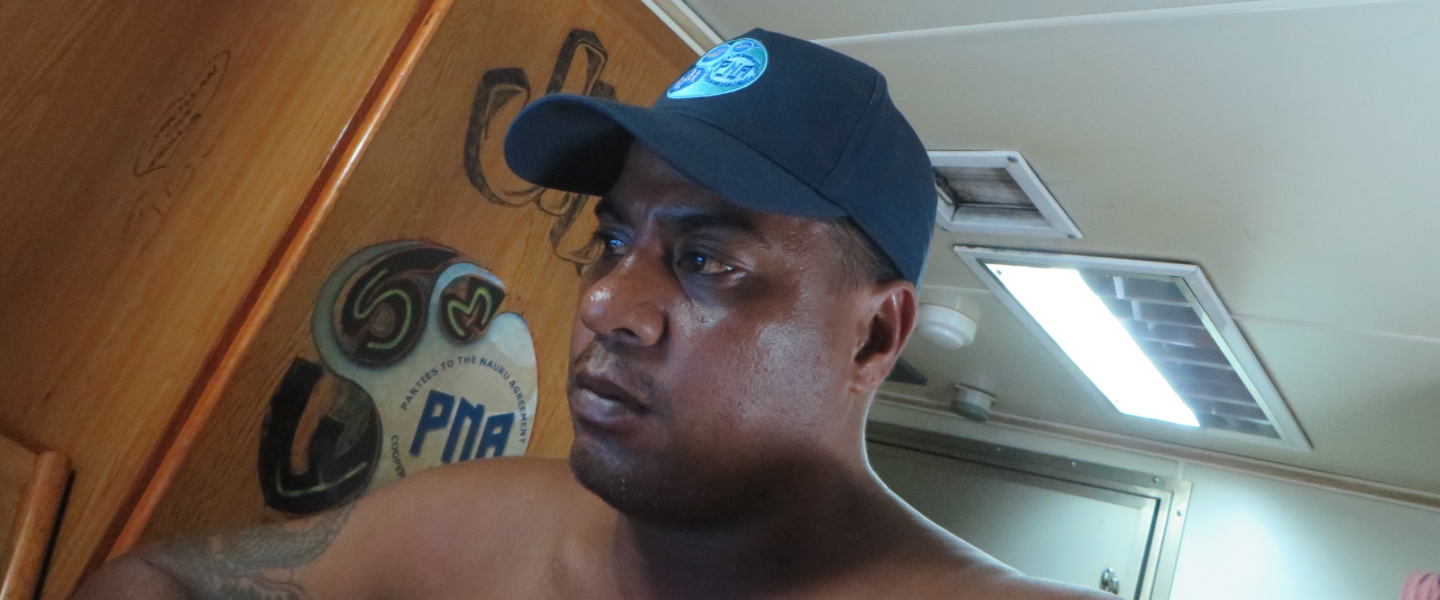
Watch the award-winning short film here: https://www.youtube.com/watch?v=A8wV4eHFnzE
Watch the film (FRENCH Subtitles) https://youtu.be/yzfTISvve8s
Watch the trailer: https://youtu.be/3zN_id2i_u0
In March 2020, Tekarara Kabangaki would receive news that would change the course of her life forever: her husband, Eritara Aati Kaierua, was found dead aboard the fishing vessel he was working on. Now, more than 5 years on, the family still lacks justice, as questions remain concerning his death and the subsequent, flawed investigation.
Death at Sea is a short documentary film directed by Sara Pipernos (Human Rights at Sea) that chronicles the life and death of Eritara Aati Kaierua through the eyes of the family he left behind. Eritara was a fisheries observer – a job that is fraught with danger and required him to hold vessels to account for regulatory offenses, such as overfishing or shark fining. He had been scared for his life before. In some cases, he had to live alongside the very people he reported on (and were made aware of such reports), thousands of miles from land. When he was found dead on the Taiwanese flagged fishing vessel, the WIN FAR 636, it was hard to imagine he had died of natural causes.
The ensuing investigation was fraught with inconsistencies.
His death, initially ruled as a homicide via blunt force trauma, was overruled as death by natural causes. Evidence was lost and mishandled, and the family was shut out.
To this day, Taiwanese authorities have yet to formally investigate despite an international obligation to do so as the flag state authority. The list goes on.
The Death at Sea film was created to highlight those injustices so Eritara’s story, and those of all observers who have died or been mistreated at sea, will not be forgotten.
The Death at Sea Justice Campaign (deathatseafilm.com), which advocates for compensation for the family, a renewed investigation into Eritara’s death, and the development of rigorous international policies that serve to protect observers, was launched in 2023.
In the last two years, the film has been screened across the globe, at closed-door government meetings in Bangkok, in front of British seafood and grocery retailers, and even at a late-night club in New York City.
The film and campaign have won accolades from the Royal Television Society and the Maritime Media Foundation and been selected at numerous prestigious film festivals, including Jackson Wild.
Now, it is time to release the film in one final push for justice for Eritara. He is not alone. More than 10 observers have died or disappeared under mysterious circumstances since 2015 alone and that is just the reported cases.
The timing of the film’s release is also necessary.
With international governance already failing fisheries observers at Sea, it’s hard to believe that the Europe Union is currently dismantling, through the Omnibus I, the Due Diligence Directive that would have better held large companies operating in Europe accountable for human rights violations and environmental degradation perpetrated in their value chains.
We are releasing the film now alongside our longstanding partners to raise awareness that these critical policies are being severely undermined, allowing corporations such as those who were implicated in Eritrea’s death, to not be held to account for human rights abuses along their supply chains.
The film was kindly supported by Human Rights at Sea, Blue Marine Foundation, the Sustainable Fisheries and Communities Trust, The Pew Charitable Trusts, and The Fishmongers Company with original 2021 contributory funding from The Seafarers Charity.
ENDS.
BACKGROUND Links
- Independent Case Review of death of Kiribati fisheries observer Eritara Aati Kaierua. 19 May 2021
- Timeline of Events in case of death of Kiribati fisheries observer Eritara Aati Kaierua. 19 May 21
- New CCTV Evidence Fuels Demand for Answers in Suspicious Death of Fisheries Observer Eritara Aati Kaierua
Source: Human Rights at Sea 2025. www.deathatseafilm.com
AI. AI was not used in the drafting of this article.
Photo Credit: Sara Pipernos.
Contact: If you have any questions, please write to us at enquiries@hrasi.org.
About Sharing. We welcome the use and dissemination of our copyrighted work with full, accurate and proper accreditation. Open Access This article is licensed under a Creative Commons Attribution 4.0 International License, which permits use, sharing, adaptation, distribution and reproduction in any medium or format, as long as you give appropriate credit to the original author(s) and the source, provide a link to the Creative Commons licence, and indicate if changes were made. The images or other third-party material in this article are included in the article's Creative Commons licence, unless indicated otherwise in a credit line to the material. If material is not included in the article's Creative Commons licence and your intended use is not permitted by statutory regulation or exceeds the permitted use, you will need to obtain permission directly from the copyright holder. To view a copy of this licence, visit http://creativecommons.org/licenses/by/4.0/.
©Copyright and Intellectual Property of Human Rights at Sea CIC (HRAS) 2025. All rights reserved.